
Land Contracts: Riskier than they appear
Despite rising costs and interest rates, homeownership remains the cornerstone of the American Dream for many. In situations where the traditional mortgage lending industry doesn’t offer affordable products or their application process poses barriers for those with low or no credit history or no social security number, these individuals may turn to riskier options such as land contracts.
What is a land contract?
A land contract—also known as “contract for deed” or “land installment contract”—is a form of alternative financing to purchase a home. The buyer makes payments directly to the seller/owner through a private contract over a specified period of time instead of a traditional mortgage lender.
Are they the same as a mortgage loan?
No. In a traditional mortgage, the buyer immediately obtains title to the home after closing. The buyer also gains equity in the home by making payments over time. In a land contract, the buyer typically does not gain equity or obtain the title or deed to the home until the contract concludes.
As a result, buyers assume many of the responsibilities of homeownership—such as maintenance, repairs, and property taxes—without the same legal protections and tax advantages enjoyed by mortgage borrowers.
If the buyer defaults during the contract, they will likely lose the value of their down payment, monthly payments, any home improvements, or increased value of the home.
Land Contracts Through History
Land contracts largely emerged in the 1930s when Black/African American borrowers, in particular, were excluded from the traditional mortgage market under various housing discrimination practices, such as racial covenants and redlining. Not being able to access a mortgage kept these Americans out of the rapidly expanding class of homeowners.
Unable to move into white neighborhoods, and unable to receive federally insured home loans even in their own neighborhoods, Black Americans, in particular, were left with little to no opportunity to buy a home. The only option available to them, often, was a land contract. These contracts were designed to fail, stripping Black families of wealth and taking advantage of the improvements they made to their homes, before kicking them to the curb and cycling on to the next victim.
Through it all, land contracts did not go away. After the foreclosure crisis, land contracts saw a reemergence as large investment companies, including private equity firms, purchased properties in bulk through foreclosure sales. Many of these homes had been left vacant and needed repairs to be habitable. Rather than repairing the homes and using them as rental properties, these investors turned to land contracts which allowed them to shift responsibility for repairs to the consumer. All the while, the consumer rarely earns the value of improvements they have made to the home unless they successfully complete the entire contract, which are often 30-year agreements.
Modern land contracts have continued to be marketed to communities of color, immigrants, and low-income borrowers as a way into homeownership for those who may feel unable to obtain a traditional mortgage.
Land Contracts in Indiana
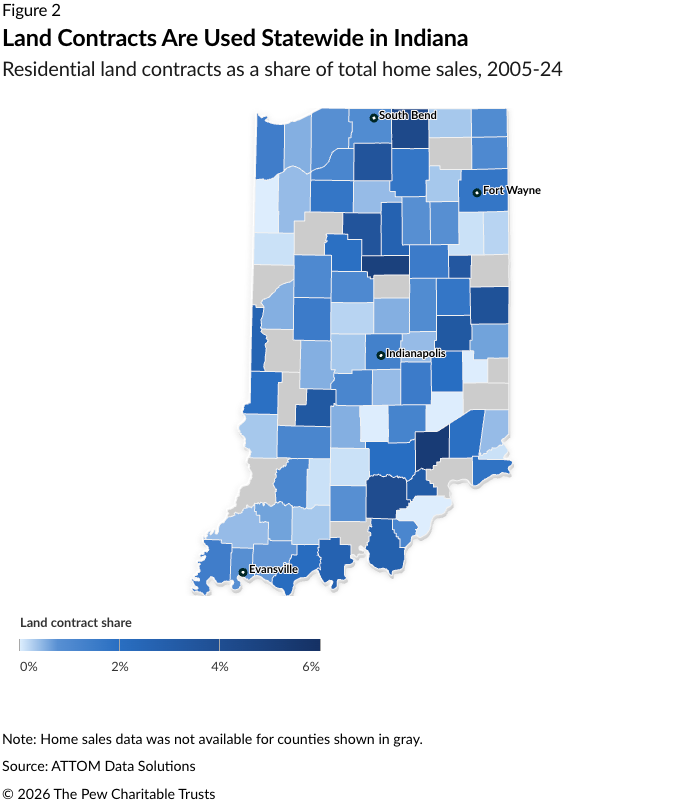
A recent Pew fact sheet found that tens of thousands of Indiana residents have used land contracts to purchase homes, farms, and other properties over the last two decades. Land contracts were often used to acquire low-cost homes, especially smaller, older homes and manufactured homes, and they are common in both rural and urban areas.
Please also review the FHCCI Education Page that discusses different types of alternative home financing.
Fair Housing Implications
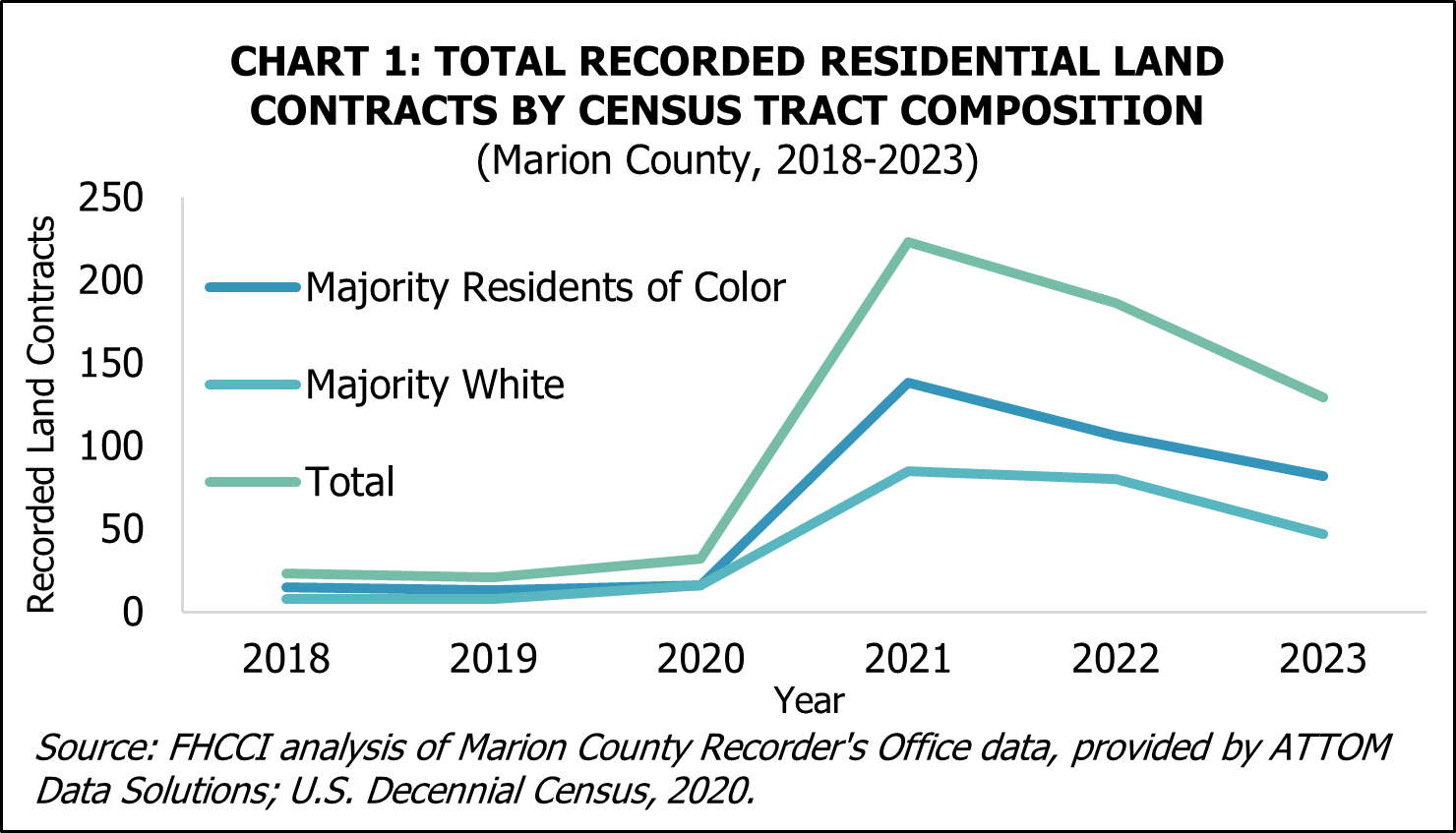
A challenge in examining the use of land contracts is a lack of comprehensive public data, but in our analysis, we found over 600 land contracts were recorded in Marion County between 2018 to 2023. Before the start of the COVID-19 pandemic, there were very few land contracts being recorded, with only 23 land contracts recorded in Marion County in 2018. After 2020, the number of recorded contracts sharply increased, but there were more prevalent in neighborhoods of color.
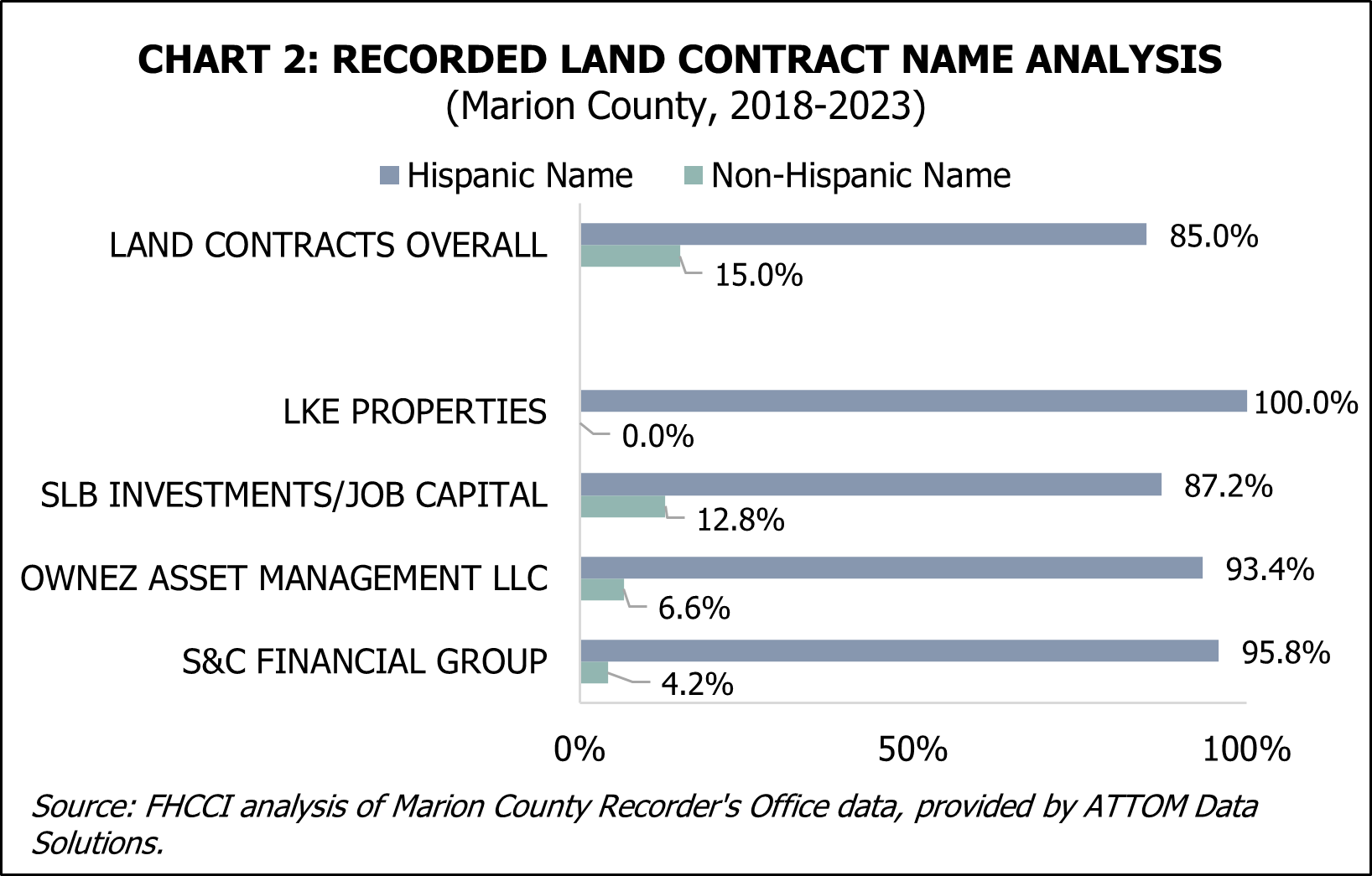
Furthermore, the FHCCI’s investigation uncovered that approximately 85% of recorded land contract recipients, in Marion County, were Hispanic consumers. Among the top land contract companies identified, that rate is even higher, with one company (LKE Properties) making 100% of their recorded land contracts to Hispanic consumers.
We also compared the transfer amounts, or purchase price, of land contracts for buyers with Hispanic names versus buyers with non-Hispanic names. On average, buyers with Hispanic names entered contracts to purchase homes about $7,000 higher in price than those with non-Hispanic names.
The FHCCI has observed that land contract companies in Indianapolis appear to be marketing heavily to the Hispanic community, advertising extensively in Spanish, and appearing at community events. They partner with Spanish-speaking real estate agents and employees to build trust with consumers. These agents may get kickbacks for every land contract they assist with. This can make the buyer vulnerable if they do not receive a truthful explanation of the contract terms or risks. They also may not receive translation of the contract in their native language.
What is the concern about land contracts?
Typically, people turn to land contracts when they don’t feel as if they could successfully obtain a mortgage from a bank. This includes people without social security numbers or people with low or no credit history.
Land contracts may contain predatory terms, like high interest rates and fees, prepayment penalties, balloon payments, and back payment of taxes. Most land contract homes are sold “as-is” and do not require an inspection. These homes are often old and in need of significant repairs. Without an inspection, buyers may not be aware of costly repairs required to make the home habitable.
Traditional mortgages include legal protections that buyers who use land contracts to purchase their home do not receive. For example, many land contracts are phrased so that the buyer can be evicted immediately if they fall behind on payments, rather than going through foreclosure, which would require court oversight and provide time for the buyer to catch up on payments.
Land contract providers often do not say explicitly that they are selling a home with a land contract. They may say “buy your home without a mortgage”, or “buy your house in installments”, or even pretend to be offering a mortgage. Many homebuyers with land contracts may not know they have one, or mistakenly think they have a mortgage.
You can learn more in the FHCCI’s 2024 report: Land Contracts: The Promise and Perils of Alternative Home Financing.
What do we want people to do?
If you are considering buying a home and worried about not having a social security number or having low or no credit history, these products may market themselves to you, but please be careful. Be sure to read the entire contract, consult with a trusted friend or family member, or an attorney, if possible, and don’t allow yourself to feel pressured or rushed into signing anything that has language in it that you do not completely understand. There are also traditional banks and mortgage companies that accept ITINs, so we encourage buyers to explore those options.
We also encourage you to contact our office to consult with one of our housing counseling team members to better understand your options and rights.
- FHCCI Brochure – Land Contracts/Alternative Financing to Purchase a Home (English/Spanish)
- FHCCI Land Contracts – What You Need to Know Fact Sheet:
- The State of Fair Housing in Indiana Report – Land Contracts: The Promise and Perils of Alternative Home Financing, Fair Housing Center of Central Indiana, June 30, 2024
- Indiana Residents Often Use Land Contracts to Purchase Low-Cost Homes Fact Sheet, Pew, May 13, 2026
- Pew Indiana Land Contract Fact Sheet (English)
- Pew Indiana Land Contract Fact Sheet (Spanish)
General fair housing information
It is unlawful to be discriminated against when buying or renting a home based on your race, color, national origin, religion, sex, disability, or the presence of minor children. For more information about your fair housing rights, please contact the Fair Housing Center of Central Indiana at 317-644-0673 or visit our website at www.fhcci.org
